
The Fail building block is used to end an automation case run in the failed state. It is typically used when your flow detects a condition that should stop execution and mark the case as failed.
See the Introduction lesson to see an example of how to use it.
Fully expanded, the Fail block shows the following properties:
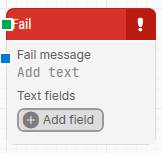
Note: The screenshot on this page uses the Elegance Design, introduced in 2025.3. If you are using an earlier version, your layout may look different.
Quick-start
-
Drag Fail onto the canvas.
-
Connect the block in the flow and optionally specify Fail message and Text fields (for tokenized values).
-
Run the flow when it’s ready.
Building block parameters
Resources
|
Topic |
Description |
|---|---|
|
Common questions about creating, running, and managing flows in Leapwork. |
|
|
Guidelines and solutions for identifying and fixing issues that occur when building or running flows in Leapwork. |