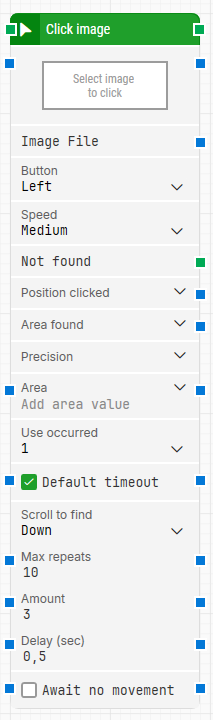
-
Block header: The green input connector in the header is used to trigger the block to start executing. The green output connector triggers when the click has been performed. If All occurrences is selected in Use occurred, the output connector triggers on each iteration until all occurrences have been clicked. The block title (“Click image”) can be renamed by double-clicking it and typing a new title.
-
Select Image: Contains the image the block will search for and then click. You can capture an image by right-clicking and selecting Capture new image, or drag and drop an Image Collection (multiple representations of the same UI element treated as one). You can edit the selected image/collection by right-clicking it, and clear it via Clear image. When the image is found, the click happens at the image’s configured interaction point, which you can adjust by clicking the image and moving the red cross-hairs.
-
Button: Selects which mouse button to use and whether the click should be single or double. The default is the left mouse button.
-
Speed: Selects the mouse movement speed. The default is Medium, which is recommended because it replays well on video. Instantaneous repositions the mouse without visible movement.
-
Not found: Output that triggers if the image is not found before the timeout. This is typically used to branch the execution flow or to explicitly fail a case by connecting it to a Fail block.
-
Position clicked: The screen position where the click was performed, in X, Y coordinates (top-left is 0, 0). This is the position of the configured interaction point, not the upper-left pixel of the image. Use the expander to work with X and Y separately.
-
Area found: The screen area where the image was found, in X, Y, Width, Height coordinates, starting at the upper-leftmost pixel (top-left is 0, 0). Use the expander to work with position and size (and nested sub-properties) separately.
-
Precision: Controls how strict the image recognition match is. In most scenarios, Pixel Perfect is preferred because it only finds exact matches. Lowering precision can help when minor background differences or rendering changes occur (for example, differences between browsers or overlays such as text on top of an image).
-
Area: Defines the screen area to search within, in X, Y, Width, Height coordinates starting at the upper-leftmost pixel (top-left is 0, 0). If no area is defined, the entire screen is searched. You can enter values manually or capture an area by right-clicking and selecting Capture area. Use the expander to work with the area’s position/size and nested sub-properties separately.
-
Use occurred: Selects which occurrence of the image to click when multiple matches are found. Select All to iterate through all occurrences; when All is selected, Current index and Completed are shown.
-
Current index: When iterating through all occurrences, this shows the current index being clicked (for example, if three occurrences are found, it will be 1, then 2, then 3).
-
Completed: Output that triggers when the iteration through all occurrences has completed.
-
Default timeout: Controls whether the block uses the flow’s default timeout or a fixed timeout. If the checkbox is not selected, the block uses 10 seconds. If the checkbox is selected, the Default timeout value from the flow settings applies.
-
Timeout: The maximum time spent searching for the image before giving up and triggering Not found. The default is 10 seconds. This block timeout is separate from the case global timeout in Settings, which can cancel a run if the whole case exceeds it.
-
Scroll to find: Enables scrolling while searching for the image when set to a value other than None. This is useful for scrollable content such as web pages and documents.
-
Max repeats: The maximum number of scroll actions to perform before giving up on finding the image.
-
Amount: The amount of scrolling performed on each scroll repeat.
-
Delay (sec): The delay, in seconds, between each scroll amount.
-
Await no movement: Delays the search for the image until the screen has shown no movement for a set period (for example, 2 seconds). This can help when waiting for UI updates such as a page load. Regardless of this checkbox, the search and click will occur after waiting a maximum of 30 seconds.
-
Await Timeout: The number of seconds the screen must have no movement before the block proceeds.