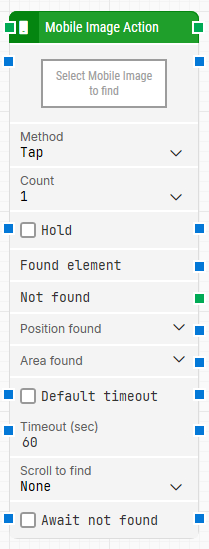
The Mobile Image Action building block performs touch gestures, such as tap, swipe, spread, and pinch; by locating a mobile image and then applying the selected action to it. This block works in image mode, where interactions are driven by image matching rather than element locators.
Fully expanded, the Mobile Image Action block shows the following properties:
Note: The screenshot on this page uses the Elegance Design, introduced in 2025.3. If you are using an earlier version, your layout may look different.
Quick-start
Drag Mobile Image Action onto the canvas.
Connect the block in the flow and specify Select Mobile Image (required), then choose Method. Depending on the selected method, configure the relevant options (for example Count and Hold, or Direction/Length). Optionally configure timeout-related settings and Scroll to find if needed.
Run the flow when it’s ready.
Building block parameters
Parameters
Block header: The green input connector triggers the block to start executing. The green output connector triggers when the mobile image action has been successfully performed. You can rename the block by double-clicking the header text and typing a new title.
Select Mobile Image: Required. Contains the locator for the mobile image to act on. Clear the selection by right-clicking the property and selecting Clear collection.
Method: Selects the action to perform on the selected mobile image.
Tap: Taps the selected image. When Tap is selected, Count and Hold are available.
Swipe: Swipes on the selected image. When Swipe is selected, Direction and Length are available.
Spread: Performs a spread (zoom in) gesture on the selected image. When Spread is selected, Length is available.
Pinch: Performs a pinch (zoom out) gesture on the selected image. When Pinch is selected, Length is available.
Count: Sets how many taps are performed when Method is Tap.
Hold: When enabled (Tap method), the block holds the tap on the image. When Hold is checked, Duration (ms) becomes available to define how long the tap is held.
Found element: Outputs the found mobile image in the application. This can be reused as a source image in other building blocks.
Not found: Triggers if the mobile image is not found before the timeout. This is typically used to branch the flow or explicitly fail a case by linking it to a Fail block.
Position found: Outputs the position where the mobile image was found as X, Y coordinates. Use the expander to work with X and Y separately.
Area found: Outputs the position and size of the found mobile image as X, Y, Width, Height. Use the expander to work with position and size and their nested sub-properties separately.
Default timeout: Controls whether the block uses the default timeout from the flow settings or a custom timeout value.
Timeout (sec): Sets the maximum time spent searching for the mobile image before the block gives up and triggers Not found. This field is used when Default timeout is not selected.
Note: All cases also have a global timeout configured in the Settings panel. This is unrelated to a single block’s timeout. However, a running case will automatically be cancelled if it runs for longer than the global timeout.
Scroll to find: Controls whether the block scrolls while searching for the mobile image.
None: No scrolling is used.
Down: Scrolls down while searching.
Up: Scrolls up while searching.
This is useful in scrollable content where items may be loaded dynamically.
Max Repeats: Sets the maximum number of scroll attempts before the block stops searching and gives up.
Await not found: When enabled, the block assumes the mobile image is currently present and waits until it can no longer be found before proceeding. This can be useful when waiting for a “Loading” message or similar indicator to disappear.