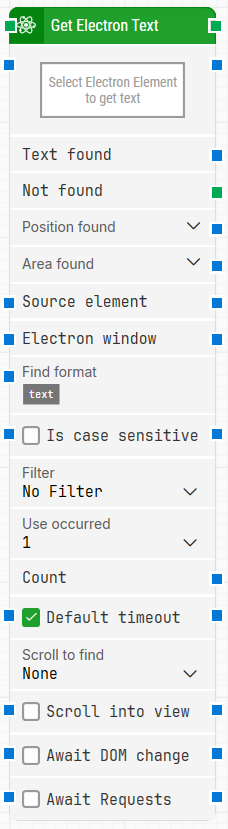
The Get Electron Text block fetches text from a specified Electron element. If the element cannot be found within the configured timeout behavior, the block triggers Not found, which can be used to branch the flow.
Fully expanded, the Get Electron Text block shows the following properties:
Note: The screenshot on this page uses the Elegance Design, introduced in 2025.3. If you are using an earlier version, your layout may look different.
Quick-start
Drag Get Electron Text onto the canvas.
Connect the block in the flow and specify Select Electron Element to get text (required). Optionally set Find format, Filter, and selection settings such as Use occurred. If needed, set Source element and Electron window to limit where the block searches.
Run the flow when it’s ready.
Building block parameters
Parameters
Block header: The green input connector triggers this block to begin execution. The green output connector is triggered when the Electron text is successfully fetched. You can rename the block by double-clicking the header text and typing in a new title.
Select Electron Element to get text: Required. Contains the locator for the Electron element from which the text is extracted. Capture a locator by right-clicking the property and selecting Capture new Electron text. Clear the locator by right-clicking and selecting Clear Electron text.
Text found: Outputs the text that was retrieved from the Electron element.
Not found: Triggers if the Electron element is not found before the timeout behavior completes. This is typically used to branch the execution flow or explicitly fail a case by linking it to a Fail block.
Position found: Outputs the application canvas position where the Electron element was found as X, Y coordinates. The top-left corner of the application canvas is 0, 0.
Area found: Outputs the application canvas position and size of the found Electron element as X, Y, Width, Height, starting with the upper-leftmost pixel. The top-left corner of the screen is 0, 0.
Source element: Limits the Electron element locator to only work inside the specified source element when you choose the Element option. This is useful when you want the locator to search within a specific region or parent element instead of the full window.
Electron window: Contains a handle to the Electron window once it is found and focused. Use this when multiple Electron windows are open to direct the block to fetch text from a specific window.
Find format: Defines a format the text must match in order to be retrieved. For example, with a format like Status: [TEXT] today, only the text inside strings such as Status: Green Mode today is returned.
Is case sensitive: Controls whether Find format matching is case sensitive. By default, matching is case insensitive.
Filter: Applies an additional filter to the retrieved text. For example, you can filter to only retrieve numbers or only retrieve text that matches a specific pattern or rule.
Use occurred: Selects which occurrence of the Electron element to use when more than one match is found. Select All to iterate through all occurrences.
Count: Outputs the total number of found Electron elements that match the locator.
Default timeout: Controls whether the block uses the default timeout from the flow settings or a custom timeout value.
Scroll to find: Controls whether the block scrolls while searching for the Electron element. When a value other than None is selected, the block uses scrolling during the search.
Scroll into view: When enabled, any found Electron element is automatically scrolled into view.
Await DOM change: Delays the search until there have been no DOM changes for a specified period (for example, three seconds). This is useful when waiting for behind-the-scenes JavaScript updates. Regardless of this checkbox, the search occurs after waiting a maximum of 30 seconds.
Await Requests: Delays the search until there have been no active XHR requests for a specified period (for example, three seconds). Regardless of this checkbox, the search occurs after waiting a maximum of 30 seconds.