-
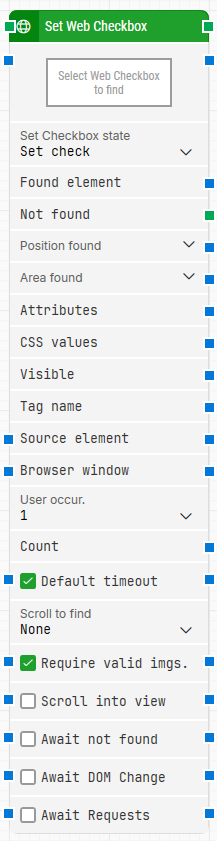
Block header: The green input connector triggers the block to start executing. The green output connector triggers when the checkbox has been set. You can rename the block by double-clicking the header text.
-
Set Web Checkbox To Find: Contains the locator for the checkbox element to be set. Capture it by right-clicking and selecting Capture new web element. You can update it via Edit web element or remove it via Clear web element.
-
Set Checkbox state: Controls whether the checkbox should be checked or unchecked.
-
Found element: Outputs the found checkbox element in the browser window. This can be reused as a Source element in other blocks to narrow down later searches.
-
Not found: Triggers if the checkbox element is not found before the timeout behavior completes. This is typically used to branch the execution flow or explicitly fail a case by connecting it to a Fail block.
-
Position found: Outputs the browser canvas position where the element was found as X, Y coordinates. The top-left corner of the browser canvas is 0, 0. Elements that are not visible typically report 0, 0. Use the expander to work with X and Y separately.
-
Area found: Outputs the browser canvas position and size of the found element as X, Y, Width, Height, starting from the upper-leftmost pixel. The top-left corner is 0, 0. Use the expander to work with position/size and nested sub-properties separately.
-
Attributes: Outputs all attributes on the found element as key–value pairs (including standard HTML attributes like class, style, href, and custom data-xxx attributes). If you only need one attribute, Get Web Attribute can be used instead.
-
CSS values: Currently unused.
-
Visible: Returns True if the found element is visible.
-
Tag name: Outputs the tag name of the found element (for example div, input, button).
-
Source element: Limits the search to only occur inside the provided source element. This is useful when you first find a container (like a table) and then search inside it.
-
Browser window: Specifies which browser window to search in. Multiple browser windows are not supported by Selenium Grid or external cloud providers such as Sauce Labs and BrowserStack.
-
Use occurred: Selects which occurrence to use if multiple matching elements are found. Select All to iterate through all occurrences.
-
Count: Outputs the total number of found web elements that match the locator.
-
Default timeout: Controls whether the block uses the default timeout from the flow settings or a custom timeout value.
-
Timeout (sec): Sets the maximum time spent searching for the checkbox element before giving up and triggering Not found. This field is used when Default timeout is not selected.
Note: All cases have a global timeout configured in the Settings panel. This is unrelated to the timeout of a single building block. However, a running case will automatically be cancelled if it runs for longer than the global timeout.
-
Scroll to find: When set to a value other than None, the block scrolls while searching for the checkbox. This is useful in scrollable pages where elements load asynchronously (for example infinite scroll).
-
Max repeats: The maximum number of scroll attempts before the block stops searching.
-
Amount: How much scrolling is performed on each repeat.
-
Delay (sec): The delay in seconds between each scroll.
-
Require valid imgs: When enabled, locators targeting images (img tags) are additionally validated to ensure the image loads correctly by checking that the image source returns an HTTP 200 response.
-
Scroll into view: When enabled, any found element is automatically scrolled into view.
-
Await not found: When enabled, the block assumes the element is currently present and waits until it can no longer be found before proceeding. This can be useful when waiting for a “Loading…” indicator to disappear.
-
Await DOM change: Delays searching until there have been no changes to the page’s DOM for a specified period (for example, three seconds). Regardless of this checkbox, the search proceeds after waiting a maximum of 30 seconds.
-
Await Requests: Delays searching until there have been no active XHR requests for a specified period (for example, three seconds). Regardless of this checkbox, the search proceeds after waiting a maximum of 30 seconds.